
Accessible entry begins before anyone sets foot inside the building. Parking lots and drop-off zones are the first welcome (or barrier) many people experience. Thoughtfully designed parking and drop-off areas are essential to making church spaces truly accessible for everyone.
This page provides practical guidance for creating accessible parking and drop-off areas that support safe arrival, clear navigation, and equitable access. The examples here represent only a selection of key ADA requirements. For full standards and technical details, please refer to the official ADA Standards for Accessible Design linked throughout this section.
Why Accessible Parking & Drop-Off Matters
For many disabled people, a safe, accessible place to park or be dropped off is not optional — it’s a necessity. Without it, they may never make it through the door. Poorly planned parking or drop-off zones can cause stress, physical danger, or exclusion before worship even begins.
- Accessible parking ensures people using mobility devices, walkers, service animals, or with limited mobility can enter with dignity.
- Drop-off zones help people who rely on rides, public transit, or volunteer drivers — especially those with limited strength or balance — access the building safely.
- Clear, well-marked, and adequately sized spaces reduce accidents, confusion, and barriers to participation.
Recommended Standards & Layout Guidelines
Use recognized accessibility standards (e.g. ADA or your local code) as a baseline — but also consider the lived experience of people with various disabilities when designing or marking parking and drop-off.
- Provide accessible parking spaces close to the main entrance. The number should reflect building capacity and attendance. (E.g. more than 1–2 spaces for larger congregations.)
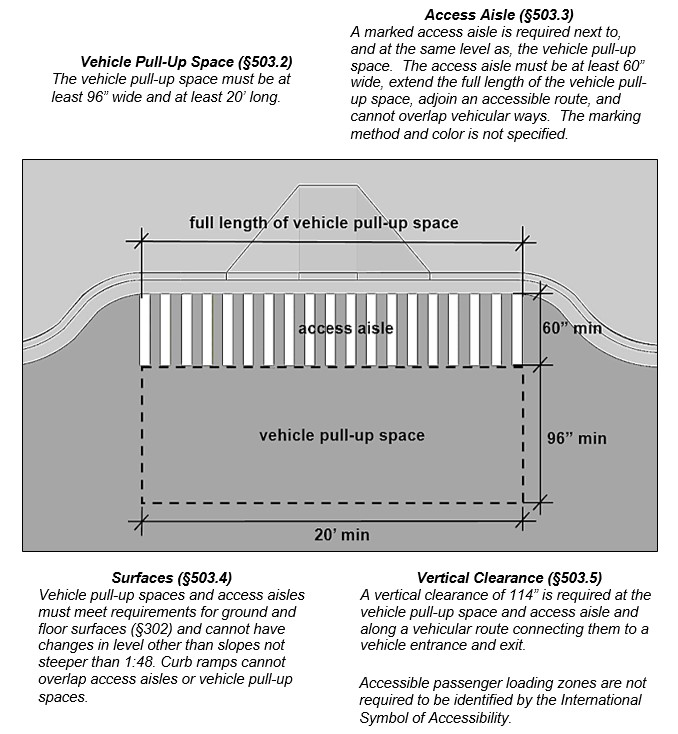
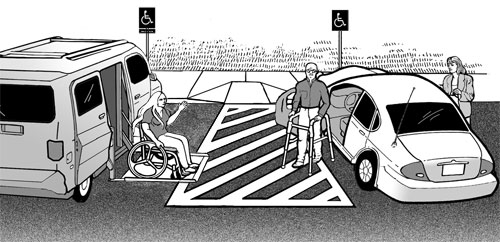
- Include at least one van-accessible space (with wider access aisle).
Note: Van-accessible spaces help people using vans with lifts or ramps, and those who need extra space for mobility aids. - Mark all accessible parking stalls clearly with visible signage and expected standards (vertical sign + ground marking). Avoid faded or missing signs.
- Design even, stable, slip-resistant surfaces for parking and path of travel from the parking lot to the entrance — free of steep slopes, cracks, gravel, or obstacles.
- Provide a designated, clearly marked drop-off zone near the entrance. Ensure adequate space for loading/unloading mobility devices or service animals.
- Ensure curb ramps or gently sloped walkways connect parking/drop-off areas to building entrances. Slopes should meet recommended ratios and avoid uneven surfaces.
- Keep accessible parking and drop-off aisles clear, well-lit, and maintained (no debris, snow, ice, or temporary obstructions during events).
| Total Number of Parking Spaces Provided in a Parking Lot or Facility | Minimum Number of Accessible Parking Spaces Permitted |
|---|---|
| 1 to 25 | 1 |
| 26 to 50 | 2 |
| 51 to 75 | 3 |
| 76 to 100 | 4 |
| 101-150 | 5 |
| 151-200 | 6 |
| 201-300 | 7 |
| 301-400 | 8 |
| 401-500 | 9 |
| 501-1000 | 2% of total spaces |
| 10001 and over | 20, plus 1 for every 100, or fraction thereof, over 1000 |
| At least 1 in every 6 spaces must be van accessible |

Practical Practices & Church-Friendly Solutions
Not every church may have a perfect parking lot or unlimited budget. Here are practical steps and flexible solutions you can implement.
- Audit your lot: Walk the parking and drop-off area with a person who uses a mobility aid or service animal and note barriers (distance, surface issues, signage, slope, lighting, access path).
- Reserve accessible stalls: Make sure accessible spaces are kept free during events — consider volunteer “parking attendants” who help maintain access.
- Temporary drop-off zones: For events, create temporary marked zones near the entrance for ride-share or driver-assisted drop-offs.
- Clear signage and lighting: Use reflective or high-contrast signs and ensure drop-off and accessible parking zones are well-lit for evening services.
- Snow/ice / debris plan: On winter or rainy days, have a volunteer or facility protocol to clear paths and accessible parking spots first, so accessibility isn’t an afterthought.
- Communicate parking access: Include info on accessible parking/drop-off in the bulletin, website, and welcome materials — so people know what to expect before arriving.
Real-Life Scenarios & Why Thoughtful Parking Matters
Scenario 1: No accessible parking close to the entrance
Problem: A person using a walker has to park far away and navigate uneven, gravel-covered ground, making entry painful or impossible.
Better practice: Reserve an accessible spot near the entrance, with a smooth path and curb ramp, and ensure it’s kept clear during services.
Scenario 2: Van-accessible stall missing or blocked
Problem: A family arriving in a wheelchair-accessible van cannot unload because the access aisle is blocked by another car.
Better practice: Clearly mark van-accessible stalls and keep the access aisle free. If necessary, assign a volunteer to direct parking during events.
Scenario 3: Poor lighting and unsafe walkways after sunset
Problem: A person with visual impairment or limited mobility risks falling or feels unsafe navigating to the entrance at night.
Better practice: Install adequate lighting along parking, walkways, and drop-off paths; maintain clear, smooth walkways; offer escort or assistance if needed.
Quick Checklist:
Parking & Drop-Off Accessibility
- Accessible parking spaces are located close to the main entrance.
- At least one van-accessible parking space with a wide access aisle is provided.
- All accessible spaces are clearly marked with signs and ground markings.
- Drop-off zone near the entrance is clearly marked and accessible.
- Paths from parking/drop-off to entrance are smooth, slip-resistant, and free of obstacles.
- Accessible parking and drop-off zones are well-signaled, well-lit, and maintained (clear of debris, snow, ice, etc.).
- For events: designate volunteers to monitor and enforce accessible parking / drop-off availability.
- Parking/drop-off accessibility information is clearly communicated in bulletins, on the website, and in welcome materials.

Resources & Further Guidance
- U.S. Access Board— Chapter 5: Explains the required number, dimensions, layout, and location of accessible parking spaces (both car and van accessible), plus how to calculate minimum needed spaces per lot or garage.
Chapter 5: Parking Spaces - 2010 ADA Standards for Accessible Design— The core regulatory standard that most public-use facilities in the U.S. must meet for parking, drop-off, and accessibility features. Great for legal/regulatory compliance and design planning.
Accessible Design Standards - ADA National Network —A clear summary of requirements (space size, van-accessible ratio, signage, access aisles), helpful as a quick reference when evaluating or designing parking lots.
Fact Sheet
Parking and drop-off aren’t small details — they’re the first invitation a church gives. When done well, they say: “You are welcome here. We have prepared a way for you to arrive safely.”